



Table of Contents
Content Warnings: death, murder, violence, blood, vampirism, suicide, loneliness and social isolation, aging and elderly characters, queer longing and unfulfilled desire, grief, period-typical homophobia (1980s flashbacks), emotional manipulation
At its core, this is a book about the kind of loneliness that persists even in a life filled with relationships. I read it on honeymoon, almost a year late because of cancer treatments, and understood immediately what Cheon Seon-Ran's vampires were hunting. That's relevant because of what cancer ghosting taught me: you can be most alone with a contact list full of outgoing messages that have spent months on read, as if 'Stage IV' leaves you socially dead before you're physically gone.
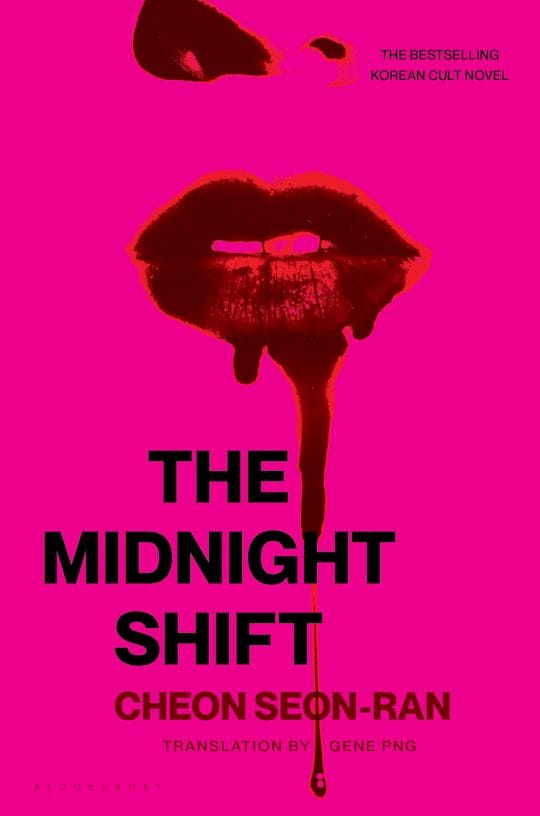
That's the blood scent that Cheon's vampires track in The Midnight Shift (originally titled 밤에 찾아오는 구원자, "the saviour who comes in the night"), sutured into English by Gene Png; structural erasure, not physical isolation. Laid out on that exam table, what could otherwise be merely Gothic decoration becomes a surgical social analysis. Png's translation hands us the scalpel.
The Midnight Shift's vampires can only be killed if they're feeding upon the unwilling, so consent becomes the incision by which the book's social surgery is performed. Cheon's framing makes this predation a social failure rather than a supernatural threat. Her vampires don't stalk those who are physically alone, as is so often the case; rather, they focus on the the socially exiled, like elderly people whose families stopped calling them or those in the queer community whose longing becomes its own kind of slow death "due to social judgement" (the author's translated phrasing).
The 1980s France flashbacks, and a formative relationship they depict, don't sentimentalise that; they show how queer intimacy and isolation wind together, and by doing so show how a resulting romance can be both a refuge as well its own peculiar abandonment.
The three narrative threads do occasionally snarl in their weaving. I'll admit that one chapter lost me for a bit, causing me to backtrack to sort out which timeline I was following.
Png's translation, on the other hand, rarely snagged on anything. I often forgot that I'm outside Korean literary traditions, except in rare moments where Png's steady hand faltered and I felt the twinging of a Korean literary nerve I can't name or touch. Those rare moments felt like overhearing snippets of conversation in a dialect I don't speak, but a language I do... which definitely isn't Korean, I assure you!
I don't know how the book reads in its original context—what resonances it carries of Korean horror traditions or in what ways Korean readers catch particular notes of queerness differently than I can.
Here's what I can see, though: the way that murder mystery mechanics are used to create a pressure that pushes characters into articulating their loneliness, and how all three narrative strands stay tangled up without one being made more important. Each of the central character has a different blood type to loneliness, and Cheon never makes any of them into a universal donor.
The author describes writing queer characters as being "simply familiar," and connecting the loneliness of aging to the queer experience of loving "but not being able to be with them." The book bleeds that connection through every page. The elderly patients whom the vampires target socially isolated by their age; queer desire isolates by social stigma.
Who will find this good literary medicine? Any reader who hungers for fiction that bleeds through multiple layers of genre. This book is queer Gothic, Korean murder mystery, meets and sociological diagnosis in one.
Leave it on the shelf if you need a happily ever after or a tidy resolution.
When I closed the book I was still uncertain about the parts of it that I'm outside of, which is why I love reading books like this. Korean literary traditions? Queer Korean contexts? With a book centred so heavily on being set apart, that uncertainty only enhances the books thesis.
Comments